A.6 RT-qPCR for BTEX and MTBE in Groundwater for Remediation (CA)
Adapted with permission from: Baldwin, B.R., A. Biernacki, J. Blair, M.P. Purchase, J.M. Baker, K. Sublette, G. Davis, and D. Ogles. 2010. "Monitoring geneA segment of DNA containing the code for a protein, transfer RNA, or ribosomal RNA molecule (based on Madigan et al. 2010). expression to evaluate oxygen infusion at a gasoline-contaminated site." Environmental Science & Technology 44(17): 6829-6834. Copyright 2010 American Chemical Society.
EMD Technology
- Primary: Reverse Transcriptase-Quantitative Polymerase Chain Reaction (RT-qPCR)
- Complementary: Quantitative Polymerase Chain Reaction (qPCR), EMD Sampling Methods
Contacts
Dora Ogles
Microbial Insights, Inc.
(865) 573-8188
A.6.1 Site Background and Knowledge from Traditional Methods
The site is an operating gasoline station located in northern California.The shallow aquifer is impacted by petroleum hydrocarbons, including benzene, toluene, ethylbenzene, and xylenes (BTEX) along with the fuel oxygenate methyl tertiary-butyl ether (MTBE).
Examination of groundwater geochemical parameters (such as dissolved oxygen, nitrate, ferrous iron, sulfate) indicated highly anaerobic conditions. Although biodegradationA process by which microorganisms transform or alter (through metabolic or enzymatic action) the structure of chemicals introduced into the environment (USEPA 2011). of BTEX and MTBE has been well documented under anaerobic conditions, historical trends in contaminant concentrations led stakeholders to believe that monitored natural attenuation (MNA) would not provide site closure within an acceptable timeframe.
An oxygen infusion system was installed in the vicinity of the dispenser islands to promote aerobic biodegradation of BTEX and MTBE. The oxygen infusion system consisted of oxygen cylinders, 2-stage regulators, manifolds, and in-well emitters (iSOC, inVenture Technologies, ON Canada; and Waterloo, Solonist, ON, Canada). For the original system, a three oxygen infusion wells (IP-1 through IP-3) and two downgradient monitoring points (MP-1 and MP-2) were installed at the site.
A.6.2 EMD Objectives and Approach
RT-qPCR was performed to quantify the expression of toluene dioxygenase (TOD) and phenol hydroxylase (PHE) genes as well as Methylibium petroleiphilum PM1 16S rRNAA subunit of the ribosome composed of ribonucleic acid (RNA). The RNA sequence is used to classify and identify microorganisms (e.g., genus and species). to address the following question: Will oxygen infusion stimulate activityRefers to when a microorganism performs a specific function (e.g., sulfate reduction, metabolism of benzene) of benzene and MTBE degrading microorganisms at the infusion point and downgradient locations?
Pure oxygen was infused through emitters installed in wells IP-1 through IP-3. Dissolved oxygen (DO) concentrations were measured periodically at the injection points and downgradient monitoring points MP-1 and MP-2 throughout system operation. Standard, unamended Bio-Traps® deployed in the injection point IP-3 and downgradient wells MP-1 and MP-2 were recovered for RT-qPCR quantification of the following:
- Toluene dioxygenase (TOD) – functional geneA segment of DNA that encodes an enzyme or other protein that performs a known biochemical reaction. For example, the functional gene tceA encodes the reductive dehalogenase enzyme that initiates reductive dechlorination of TCE. Other genes can code for RNA entities which can regulate the activity of other DNA target sequences. encoding a key enzyme in one of the pathways for aerobic biodegradation of benzene and toluene. TOD expression demonstrates that aerobic benzene and toluene utilizing bacteria are active.
- Phenol hydroxylase (PHE) – functional gene encoding a monooxygenase enzyme in a different pathway for aerobic BTEX biodegradation. Like TOD, expression of PHE genes indicates that aerobic BTEX degrading bacteria are active.
- Methylibium petroleiphilum PM1 16S rRNA (PM1) – quantifies 16S rRNA from one of the few known bacteria capable of aerobic metabolism of MTBE and TBA.
A.6.3 Results
As discussed in detail in Baldwin et al. 2010, the impact of system operation at the oxygen infusion point can be summarized as described below (see Figure A.6-1):
- Prior to system activation, PHE and TOD expression was not detected at IP-3 (Figure A.6-1), MP-1 (Figure A6.2A), or MP-2 (Figure A.6-2B) indicating that these pathways for aerobic BTEX biodegradation were not active under existing site conditions. Likewise, PM1-like 16S rRNA was not detected prior to system activation indicating that one of the few known MTBE metabolizing microorganisms was not active.
- After system startup and during operation, DO levels at the infusion point IP-3 rapidly increased and remained on the order of 30 to 40 mg/L.
- After about 200 days of operation, PHE transcripts and PM1 rRNA were detected on the order of 103 and 105 copies/bead respectively at IP-3. Thus, oxygen infusion had stimulated aerobic BTEX degrader activity at least at the infusion point.
- When the system was deactivated for maintenance and upgrades (days 225-300 and days 550-650), DO levels at the infusion points decreased rapidly. However, once the system was reactivated, PHE and TOD expression as well as PM1 16S rRNA were again detected at IP-3 demonstrating the activity of aerobic BTEX and MTBE degraders in response to system operation.
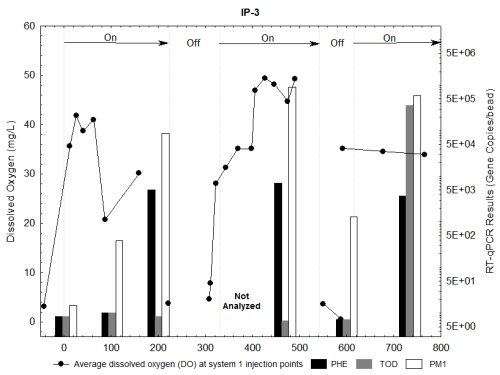
Figure A.6-1. RT-qPCR results for quantification of M. petroleiphlilum 16S rRNA and expression of phenol hydroxylase and toluene dioxygenase genes at the oxygen infusion point IP-3.
Source: Adapted with permission from Baldwin, B.R., A. Biernacki, J. Blair, M.P. Purchase, J.M. Baker, K. Sublette, G. Davis, and D. Ogles. 2010. Monitoring gene expression to evaluate oxygen infusion at a gasoline-contaminated site. Environmental Science & Technology 44(17): 6829-6834. Copyright 2010 American Chemical Society.
- While the system was deactivated (day 600), PHE and TOD expression decreased to below detectable levels at IP-3 thus linking the aerobic BTEX degrader activity to system operation. PM1 16S rRNA abundance also decreased dramatically during system shutdown.
While RT-qPCR demonstrated stimulation of aerobic BTEX and MTBE degraders at the infusion point, questions remained regarding the radius of influence of the system. As discussed in detail in Baldwin et al. 2010, RT-qPCR results also demonstrated that system operation stimulated activity of BTEX and MTBE degrading bacteria at the downgradient wells MP-1 and MP-2 even though DO levels remained low (Figure A.6-2A and B).
- At the downgradient monitoring points MP-1 and MP-2, DO levels never increased even during periods of consistent system operation. Thus, by conventional measures, MP-1 and MP-2 were beyond the radius of influence of the system.
- During the first 200 days of system operation, PHE and TOD expression was not detected at either downgradient well.
- By day 450 however, RT-qPCR analysis revealed expression of two pathways for aerobic BTEX biodegradation (PHE and TOD) and activity of MTBE utilizing strain PM1 at downgradient monitoring point MP-1 (Figure A.6-2A). Although at a lower concentration, PM1 16S rRNA was also detected further downgradient (Figure A.6-2B).
- While the system was deactivated for maintenance around Day 550, PHE and TOD expression decreased to below detectable levels MP-1 and PM1 16S rRNA was no longer detected at MP-2.
- Once the system was reactivated, PHE and TOD expression as well as PM1 16S rRNA were again detected at the downgradient wells.
- Therefore, the RT-qPCR results demonstrated that, after an initial lag period, system operation stimulated aerobic BTEX and MTBE degrader activity at the downgradient locations which would not have been predicted based on geochemical monitoring alone.
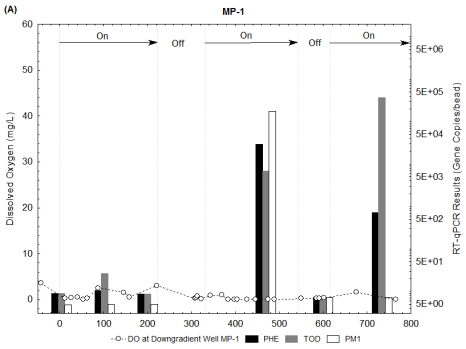
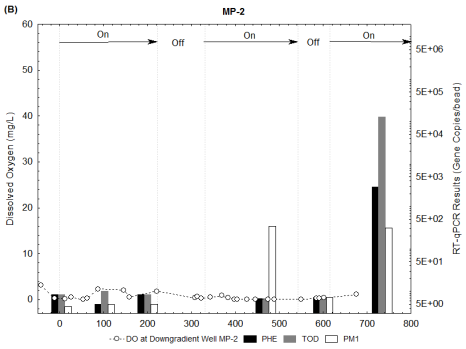
Figure A.6-2. RT-qPCR results for quantification of M. petroleiphlilum 16S rRNA and expression of phenol hydroxylase and toluene dioxygenase genes at downgradient monitoring points MP-1 (A) and MP-2 (B).
Source: Adapted with permission from Baldwin, B.R., A. Biernacki, J. Blair, M.P. Purchase, J.M. Baker, K. Sublette, G. Davis, and D. Ogles. 2010. Monitoring gene expression to evaluate oxygen infusion at a gasoline-contaminated site. Environmental Science & Technology 44(17): 6829-6834. Copyright 2010 American Chemical Society.
RT-qPCR analysis provided site managers with rapid feedback (7-10 day turnaround time) on the effect of system operation on BTEX and MTBE degrader activity before trends in contaminant concentration would have been evident. Ultimately, the changes in contaminant concentrations were consistent with the RT-qPCR results demonstrating aerobic BTEX degrader activity.
- At the infusion point IP-3, system operation and PHE expression corresponded with decreases in benzene concentrations (Figure A.6-3A).
- Note the spike in the benzene concentration in IP-3 at Day 600. When the system was deactivated, PHE and TOD were no longer expressed and the benzene concentration increased substantially. When the system was reactivated, PHE and TOD expression was evident and benzene concentrations again decreased.
- Despite the consistently low DO levels at MP-1 and MP-2, RT-qPCR demonstrated that aerobic BTEX and MTBE degraders became active after initial lag periods.
- At MP-2 however, benzene concentrations were stable or increasing through much of the study. The observed lag but eventual expression of PHE and TOD at MP1 by day 500 (Figure A.6-2A) improved stakeholder confidence that system operation would eventually enhance benzene biodegradation at MP-2 at a time when benzene concentrations were actually increasing (Figure A.6-3B).
- By day 750, when PHE and TOD expression was evident, benzene concentrations had begun to decrease.
- RT-qPCR analysis provided the critical link between system operation, expression of functional genes involved in aerobic BTEX, BTEX degrader activity, and ultimately observed decreases in contaminant concentrations (Figure A.6-3).
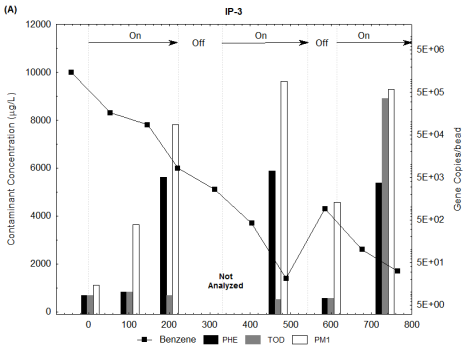
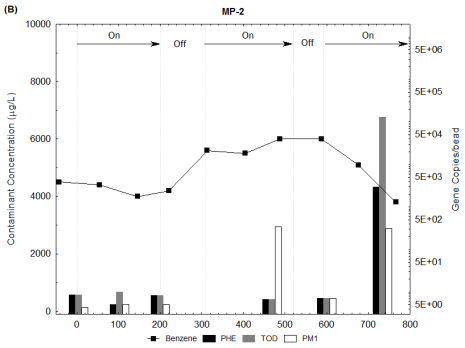
Figure A.6-3. RT-qPCR results and dissolved benzene concentrations at the oxygen infusion point IP-3 (A) and downgradient monitoring point MP-2 (B).
Source: Adapted with permission from Baldwin, B.R., A. Biernacki, J. Blair, M.P. Purchase, J.M. Baker, K. Sublette, G. Davis, and D. Ogles. 2010. Monitoring gene expression to evaluate oxygen infusion at a gasoline-contaminated site. Environmental Science & Technology 44(17): 6829-6834. Copyright 2010 American Chemical Society.
A.6.4 Conclusions
The following conclusions can be drawn based on the results for this site:
- Documenting PHE expression at IP-3 during the first six months of operation provided rapid evidence that the infusion system would achieve its primary goal of enhancing BTEX biodegradation in the source area before a clear trend in contaminant concentrations would have been evident.
- RT-qPCR analysis demonstrated that system activation stimulated expression of a known pathway for aerobic BTEX biodegradation and activity of a known MTBE utilizing strain.
- RT-qPCR results demonstrating stimulation of aerobic BTEX and MTBE degrader activity was a critical line of evidence in the decision to install a second oxygen infusion system sidegradient of the original system.
- Overall, RT-qPCR analysis provided direct evidence of enhanced biodegradation at times not evident in chemical or geochemical results and provided the basis for greater stakeholder confidence in the remediation strategy.
A.6.5 Costs
Continued RT-qPCR monitoring of TOD and PHE expression along with PM1 16S rRNA (three target genes) would cost approximately $575 per sample.
A.6.6 Outcomes and Challenges
- The RT-qPCR results were accepted as a valuable line of evidence and the system was ultimately expanded to a total of 11 oxygen infusion points.
- As described in the qPCR section, RT-qPCR that quantifies gene expression is often more appropriate than qPCR when evaluating biodegradation of petroleum hydrocarbons (see Section 4).
- RT-qPCR can provide a more accurate delineation of the zone of influence of an aerobic treatment system than DO monitoring.
A.6.7 References
Baldwin, B.R., A. Biernacki, J. Blair, M.P. Purchase, J.M. Baker, K. Sublette, G. Davis, and D. Ogles. 2010. "Monitoring gene expression to evaluate oxygen infusion at a gasoline-contaminated site." Environmental Science & Technology 44(17):6829-6834.
Publication Date: April 2013